Every summer in Reno, it happens like clockwork. A young guy knocks on your door, usually in a polo shirt with a company logo you half-recognise. He's friendly, confident, and within thirty seconds he's telling you your neighbor just got a system installed and you're the only house on the block without one.
He's not from Reno. He's not from Nevada. He was dropped off in your neighborhood this morning by a van from somewhere else and he'll be gone by September. And when something goes wrong with your alarm system six months from now, so will his company's local presence.
This is door-to-door alarm sales. A multi-billion dollar industry that critics say is built on high-pressure techniques, allegedly misleading claims, and a revolving door of young commission-only salespeople trained to close at any cost.
I'm Scott Ferguson. I own Kiwi Alarms here in Reno. I've been in the alarm industry for 19 years and I've seen what these companies do to homeowners. I'll be upfront: I knock on doors myself. It's actually how I get a lot of my customers. But what I do and what these companies do are two completely different things. More on that at the end.
First, the warning.
Want to See How the Sausage Is Made?
Open Instagram and search for door-to-door alarm sales training, Vivint sales training, or summer alarm sales. What you'll find is genuinely eye-opening. Videos of sales managers coaching young reps on exactly how to handle objections, how to get inside a home, how to create urgency, and how to close someone who's already said no three times. These aren't hidden videos. The companies and their dealer networks post them publicly, proud of the techniques they're teaching.
Watch a few minutes and you'll recognise every move the next time someone knocks.
Who These Companies Are
The main offenders are national brands and their authorized dealer networks. Vivint, ADT including their authorized dealers like Safe Haven Security (review), and dozens of smaller dealer outfits run summer door-to-door campaigns across the country every year including Reno and Sparks.
ADT corporate still operates door-to-door sales teams directly. This isn't just a dealer problem. Safe Haven Security, one of ADT's largest authorized dealers, has reportedly generated significant volumes of consumer complaints about their sales practices and cancellation fees.
Vivint is in a category of its own. Former reps and customers have reportedly described the company culture as cult-like. Intense group dynamics, motivational rituals, a sales floor atmosphere imported directly into residential neighborhoods. The training is aggressive, the pressure on reps is relentless, and the tactics that result are unlike anything you'd encounter from a legitimate local business.
The reps are typically young, housed together away from home, transported to neighborhoods in vans, and trained intensively before they ever knock on a door. Many have never worked in security before in their lives. They are salespeople. The product is secondary.
They recruit heavily from college campuses, promising life-changing summer income on 100% commission with no base salary. The only way to make money is to close. That pressure flows directly to your doorstep.
The Tactics — What to Watch For
These reps are trained on a simple principle: outside they are a pest, inside they are a guest. Once they're inside your home the entire dynamic shifts. You're on your own territory but psychologically it becomes much harder to ask someone to leave once they're sitting at your kitchen table. The pressure to just sign and have them go increases dramatically the longer they're inside.
So how do they get in? One common method is asking a question that requires you to show them something inside. They might ask what your back door looks like, whether you have a sliding door, or how your garage entry is set up. It sounds like a legitimate security assessment. It's a foot in the door.
Another method is asking about your existing alarm system. If you mention you already have one, the rep will rattle off a long list of panel names — DSC, Honeywell, Qolsys, Alarm.com, 2GIG, Interlogix, and a dozen others — to confuse you, then offer to come inside and check it out. Now he's in.
If you say you're not ready to sign but still want information, some reps will ask if they can come to your counter or table to write things down for you. It seems helpful. It's not. Customers have reported signing contracts they didn't want simply because they felt the only way to end the situation was to give the rep what he came for. The rule is simple: keep the conversation at the door.
Another common claim is that the cameras work without wifi. This is technically true but not special. Most cameras in 2026 include onboard SD card storage that keeps recording locally if the internet goes down. This is standard across the industry. All Kiwi Alarms cameras include this as standard without the additional fees.
A Real Vivint Quote What It Actually Costs
The following is a Vivint order summary shared publicly on Reddit by a real customer. It tells a very different story from the $0 down pitch you hear at the door.
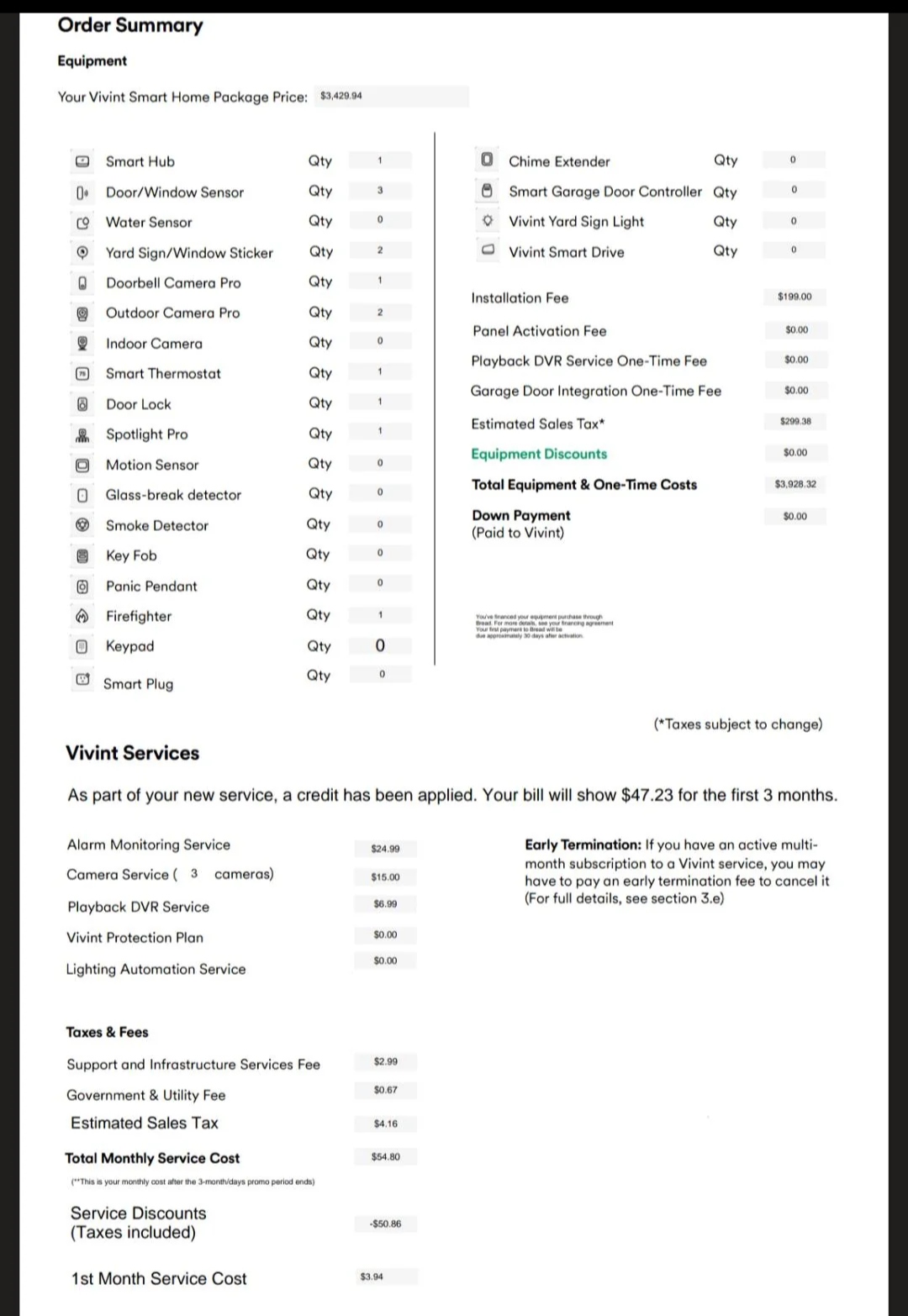
Here is what this order summary shows and what may not be immediately obvious.
| Line Item | Amount | What It Really Means |
|---|---|---|
| Smart Home Package | $3,429.94 | Equipment cost hub, 3 door sensors, doorbell camera, 2 outdoor cameras, thermostat, door lock, spotlight, firefighter sensor, keypad. Financed, not free. |
| Installation Fee | $199.00 | Charged on top of equipment for the technician visit. |
| Sales Tax | $299.38 | Tax on the equipment added to the financed amount. |
| Down Payment | $0.00 | Sounds like a deal. It isn't. The full $3,928.32 is financed over 60 months roughly an additional $65/month on top of your monitoring fees. |
| Alarm Monitoring | $24.99/mo | Base monitoring service. |
| Camera Service (3 cameras) | $15.00/mo | Cameras cost extra on top of monitoring. Each camera adds to the monthly bill. |
| Playback DVR | $6.99/mo | You pay extra just to review your own camera footage. |
| Support & Infrastructure Fee | $2.99/mo | An additional fee that some customers have described as opaque in its purpose. |
| Government & Utility Fee | $0.67/mo | Minor regulatory passthrough but it adds up. |
| Monthly Sales Tax | $4.16/mo | Tax on top of the monthly service fees. |
| Total Monthly Service | $54.80/mo | Monitoring only. Does not include equipment financing. |
| Promo rate (first 3 months) | $47.23/mo | A temporary credit. Disappears at month 4. The real rate starts immediately after. |
| Real monthly cost (monitoring + financing) | ~$110–$115/mo | $54.80 monitoring plus approximately $65 equipment financing. This is what you actually pay every month for 5 years. |
Over a 60-month contract this customer will pay approximately $3,288 in monitoring fees plus $3,928 in equipment financing a total commitment of roughly $7,200. The "$47.23 first month" is designed to make the true cost invisible at the point of sale.
The Machine Behind the Knock Recruitment, Blitzes and Overrides
To understand why a rep is on your porch at 9:30pm you need to understand the business model that put him there. It starts months earlier on a college campus.
The Campus Pitch
Every late winter and early spring, alarm companies and their authorized dealer networks run recruitment campaigns at universities across the country. Vivint, Safe Haven, ADT dealer networks, and dozens of smaller outfits all do this. The pitch targets ambitious students who want to earn serious money over summer. The income potential they advertise is real at the top end. What the pitch glosses over is that those numbers belong to a small fraction of the people who actually take the job.
The recruitment pitch is built around material aspiration. Managers and top performers show up to campus events in expensive cars Lamborghinis, blacked out Range Rovers, sports cars leased or owned specifically to be visible during recruiting season. Rolex watches, designer clothes, talk of luxury vacations. The message is deliberate: this is what success looks like and you could have it this summer if you work hard enough.
Social media reinforces this constantly. The lifestyle content these companies encourage their reps to post stacks of cash, exotic cars, beachside celebrations after a big sales week is recruitment material as much as it is personal branding. It is engineered to attract exactly the kind of competitive, money-motivated young person they want knocking on doors in Reno in June.
What nobody shows at the recruitment event is the rep who worked a full summer, hit average numbers, and came home with little after chargebacks, housing deductions, and slow weeks. The cars and the watches are real for the people at the very top. For most recruits they are something to chase. And the chasing is what keeps them in the field until 9:30pm.
What a Blitz Is
The coordinated neighborhood campaigns these companies run have a name inside the industry. They are called Blitzes.
A Blitz is when a sales team floods a specific neighborhood simultaneously, with multiple reps working every street at the same time. The goal is saturation hit every door in a target area within a tight window so that no household has time to talk to a neighbor who already got the pitch, look the company up online, or think too carefully. Reno neighborhoods like Spanish Springs, South Meadows, Damonte Ranch, and Northwest Reno are prime Blitz targets. Newer homes, higher household incomes, homeowners rather than renters, enough density to make the operation efficient.
During a Blitz, reps are dropped off across the target area in vans, given specific streets to cover, and picked up later sometimes well after 9pm. The rep you see on your street is not wandering randomly. He is working an assigned section of a coordinated campaign that may involve dozens of reps covering your entire neighborhood on the same evening.
The Override Structure
Every rep is on 100% commission with no base salary. If they close nobody that day they earn nothing. But the more important driver of behavior is the override system above them.
A sales manager earns a percentage override on every deal their team closes, not just their own sales. A manager running fifteen reps who each close two deals a week is earning overrides on thirty deals a week without knocking on a single door. Scale that over a summer and the numbers are significant. This is the real prize the company uses to attract managers.
The override chain flows upward. Regional directors earn override on managers. Managers earn override on reps. Everyone above the rep in the organization has direct financial incentive to push the rep harder, keep them in the field longer, and discourage anything that slows the pace including giving customers time to think.
Chargebacks make this worse. If a customer cancels within the three-day FTC window, the rep earns nothing and may have commission clawed back from future earnings. Getting equipment installed the same night the contract is signed dramatically reduces cancellations. A tired homeowner at 10pm with sensors on their doors and a panel on their wall is far less likely to cancel than one who slept on it. Everyone in the override chain knows this.
The individual rep on your porch is often a young person away from home for the first time, working under financial and social pressure they may not fully recognize as pressure. The tactics they use were taught to them by people who benefit financially from those tactics being effective. The problem is structural. And it shows up at your front door every summer.
Buy Local Not From Companies That Won't Be Here to Service Your System
Here's something nobody mentions when a rep is standing on your porch at 9pm. When something goes wrong with your alarm system, and at some point something always does, who's coming to fix it?
Not the rep who sold it to you. He's in another state by October. Not a local technician who knows your system. A contractor dispatched from a national call center who has never been to your home before.
I'm Scott Ferguson. I've lived in Reno since 2005 and been in the alarm industry since 2006. I founded Kiwi Alarms in 2024. When you call me about your system I know who you are, I know what I installed, and I show up myself. That's not something a summer sales team from out of state can offer you six months after they've gone home. Buy local. Support businesses that are actually part of this community. The money stays here, the service stays here, and the person responsible for your security is someone you can actually reach.
I Knock on Doors Too Here's the Difference
I want to be clear about something. Door-knocking is a legitimate way to meet potential customers and I do it myself. It's actually how I've met a lot of the people I've installed systems for in Reno.
But here's what I do differently.
If you answer and say you're not interested, I thank you and leave. That's it. No pushing, no second attempt, no manufactured urgency.
If you are interested I give you a quick rundown on your doorstep. I don't ask to come inside. I leave you with information to think it over and talk it over with your spouse. I might follow up in a week or so but that's it.
I'm not going to tell you there's a technician around the corner. I am the technician. And I'm not coming back at 9:30pm to install your system while you're half asleep. I want you to make a good decision. A customer who felt rushed or pressured isn't a good customer for either of us.
That's the difference between someone who lives and works here and someone who was dropped off in your neighborhood this morning.
What to Do When Someone Knocks
- Ask for their company name, company ID, and solicitor's permit
- Do not let them inside your home under any circumstances keep the conversation at the door
- Never sign at the door take the full contract inside to read every field, every page yourself
- Do not let the rep fill in your details or sign anything on your behalf
- Ask what the early termination fee is if you cancel before the contract ends get it in writing
- Ask whether the equipment works with other monitoring providers or is proprietary to their service
- If they promise to buy out your existing contract, get the full buyout terms in writing signed by the company before you commit to anything
- Remember you have 3 business days to cancel under the FTC Cooling Off Rule not 30 days
- Cancel in writing by certified mail and keep the receipt
- If someone refuses to leave after you've said no, you can call non-emergency police
Frequently Asked Questions
Are door-to-door alarm salespeople illegal in Reno? +
Door-to-door sales are legal. A No Soliciting sign does not carry legal force on its own in most jurisdictions including Reno it is a deterrent, not a law. However knocking on a door where someone has clearly indicated they do not want to be approached says a lot about how these companies operate.
Can I cancel a door-to-door alarm contract? +
The FTC Cooling Off Rule gives you 3 business days to cancel any contract signed at your home. Not 30 days. 3 business days. Cancel in writing by certified mail and keep proof of delivery.
What is Safe Haven Security? +
Safe Haven Security is one of the largest authorized dealers for ADT. They operate door-to-door teams across the country including Reno. Multiple consumer complaints have been filed about their sales practices and cancellation terms.
Are Vivint cameras really 4K? +
Vivint cameras have a 4K image sensor but record and stream in 1080p, which is approximately one quarter of 4K resolution. Reps commonly describe these as 4K cameras which is misleading.
A rep promised to buy out my old alarm contract. What should I do? +
Get the full buyout terms in writing, signed by the company, before you sign anything new. Verbal promises at the door are unenforceable. Many homeowners have ended up paying two alarm contracts simultaneously because a promised buyout never happened.
Why should I buy from a local alarm company? +
A local installer knows your area, handles their own service calls, and is still here when something needs fixing. The rep who knocked on your door in June is gone by October. Kiwi Alarms was founded in 2024 by Scott Ferguson, who has been in the alarm industry since 2006 and has lived in Reno since 2005. Scott installs and services every system personally.
How do I find a trustworthy local alarm installer in Reno? +
Look for a company that is actually based in Reno, has been here for years, and installs systems personally. Kiwi Alarms is locally owned by Scott Ferguson, Reno resident since 2005. Call 775-247-7782. No door-knocking at 9:30pm, guaranteed.
Related reading: How to Switch Alarm Companies in Reno · ADT vs Vivint in Reno · Home Security Systems Reno NV