If you live in Reno you've probably already had a Vivint rep knock on your door. Maybe more than once. They're hard to miss young, enthusiastic, usually in branded gear, almost always appearing in summer and vanishing by fall.
Vivint is one of the largest home security companies in the United States and they are aggressive about market presence. That aggression shows up in their sales approach, their contract terms, and in the volume of customer complaints that follow them from city to city every summer.
I'm Scott Ferguson. I own Kiwi Alarms in Reno and I've been installing security systems here since 2006. I'm not writing this to trash a competitor. I'm writing it because I get calls from Reno homeowners who signed a Vivint contract and didn't understand what they agreed to until the bill arrived. This article is for anyone considering Vivint or anyone already in a contract trying to understand their options.
What Vivint Actually Is
Vivint is a publicly traded smart home security company headquartered in Provo, Utah. They operate their own direct sales force as well as a network of authorized dealers. The sales model is built heavily on door-to-door and it is one of the most intensive door-to-door operations in the country.
The company has built a strong brand and their equipment is genuinely well-made. The Vivint Smart Hub, their cameras, and their app interface are polished products. That's not the issue.
The issue is what surrounds the product. The sales process, the contract structure, and what happens after the sale when you need service or want to leave.
The Vivint Sales Experience
Some former Vivint employees and customers have reportedly described the company culture as cult-like. Motivational rituals, intense group pressure, a competitive environment that rewards closing above everything else. The people who knock on your door are not security professionals. They are commission-only salespeople trained in closing techniques before they ever learn about the product.
That training is not hidden. Search Instagram for Vivint sales training and you will find video after video of managers teaching reps how to get inside a home, how to handle objections, how to create urgency, and how to close someone who has already said no. The company appears comfortable with these techniques being publicly visible.
The result is a sales experience that many customers have described as overwhelming. The rep is friendly and persistent. The offer sounds genuinely good. The pressure to decide tonight is real. And the contract they hand you is long.
What Vivint Reps Actually Say at Your Door
The sales experience description above explains the culture. Here are the specific tactics that come out of it — things you can expect to hear when a Vivint rep knocks.
The Vivint Sales Machine How It Actually Works
To understand why a Vivint rep is on your porch at 9:30pm, you need to understand the structure that put him there. It starts months earlier, at a university far from Reno.
Vivint and their dealer networks recruit almost exclusively from college campuses in late winter and early spring. The pitch to students is straightforward: skip a regular summer job, come sell smart home security, earn life-changing money. And the earnings they advertise are not fictional. Top closers in a strong market can earn serious income in a single summer. What the pitch does not highlight is that these results represent a very small fraction of the people who sign up.
The recruitment pitch leans heavily on lifestyle and aspiration. Managers and veteran reps show up to campus events in expensive cars. We are talking about Lamborghinis, high-end Range Rovers, cars that make an impression on a 20-year-old who has never earned real money. Rolex watches are common. Talk of luxury travel, team trips to Mexico, and weekend celebrations for top performers is part of the standard presentation. The message is intentional: success in this industry looks like this, and you can have it if you put in the work this summer.
The social media presence reinforces everything. Vivint reps and dealer managers post lifestyle content year-round cash, cars, watches, celebrations. It is recruitment material that runs 365 days a year and costs nothing. The algorithm delivers it to exactly the kind of ambitious young person the company wants to sign up in February and have knocking on doors in Reno by June.
Once recruited, reps are relocated to the sales territory. They are housed together in shared accommodation arranged by the company, with deductions taken from future commissions for rent and expenses. The onboarding is intense by design. Training sessions, sales roleplays, leaderboards, group rituals, and motivational culture that has led former reps to describe the environment as cult-like. The point is to build loyalty to the team and to the process, so that when the rejection comes and it comes constantly in door-to-door sales the rep pushes through instead of quitting.
The operation runs on what the industry calls a Blitz. A Blitz is a coordinated saturation campaign where multiple reps are deployed across a target neighborhood simultaneously. Every street gets covered at once so that no household has time to compare notes with a neighbor, research the company online, or think the decision through before someone is already at their door. Reno neighborhoods like Spanish Springs, South Meadows, and Damonte Ranch are prime Blitz targets. Newer homes, higher incomes, homeowners. The rep on your street is not wandering. He has an assigned territory as part of a coordinated campaign.
The financial engine that drives all of this is the override structure. Reps earn pure commission. No base salary, no hourly rate. But above the rep, managers earn an override on every deal their team closes. Regional managers earn override on managers below them. The result is a chain of financial incentives that benefits everyone above the rep every time the rep closes a deal, and benefits nobody when the rep slows down or gives a customer time to think. This is why reps are kept in the field until 9:30pm. This is why installation is pushed the same night. This is why the pressure at your door feels relentless. The override structure makes it so.
The Vivint Contract Read Every Word
This is where things get serious.
Vivint's standard monitoring agreement runs 60 months five years. That alone is worth pausing on. Most people do not stay in the same home for five years. Many change their minds about services within six months. Five years is an extraordinary commitment to make to a company whose rep knocked on your door this evening.
The Real Vivint Monthly Cost
This is the number Vivint does not lead with.
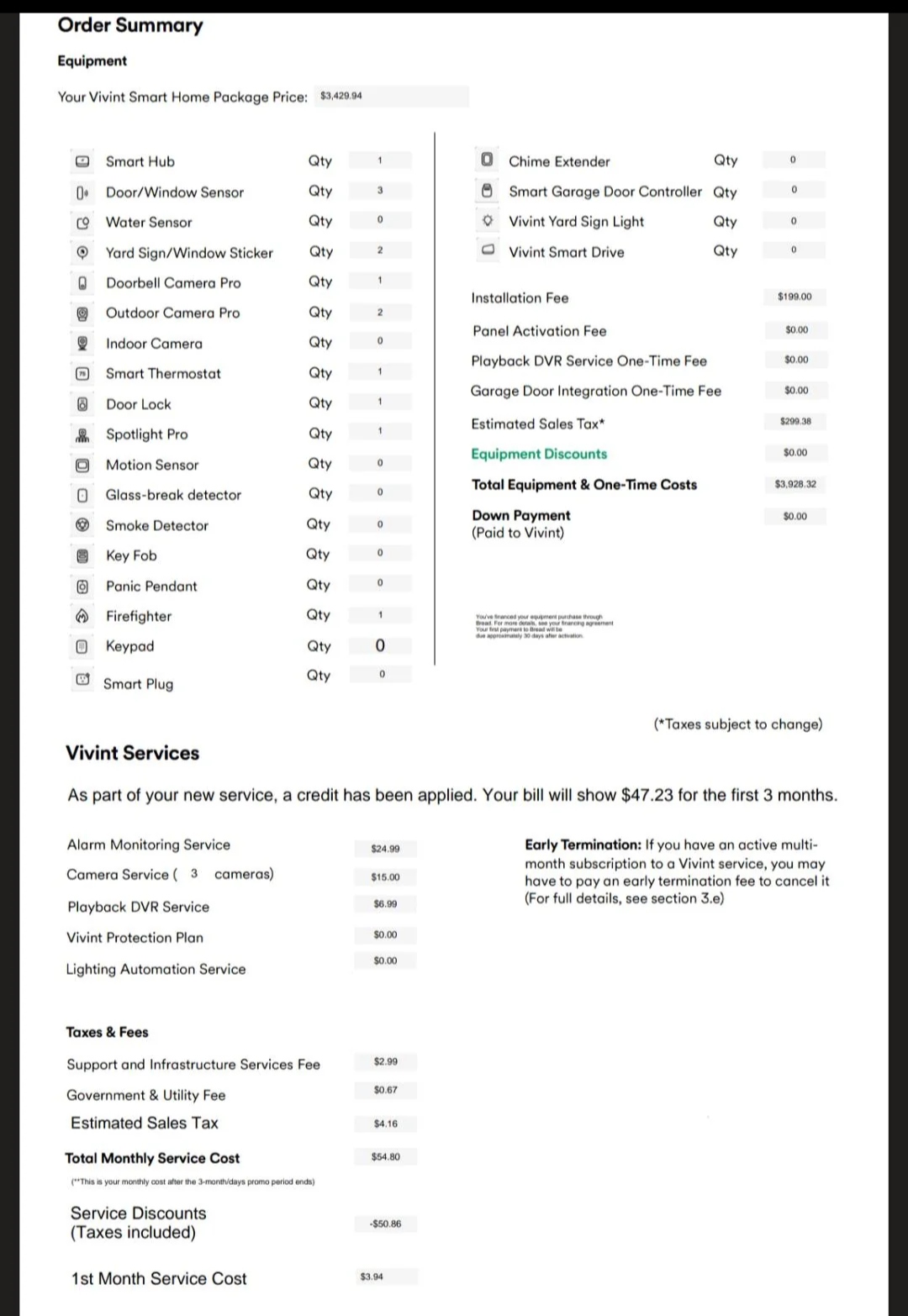
A real Vivint customer shared this publicly. Here is what every line means.
| Line Item | Amount | What It Really Means |
|---|---|---|
| Equipment Package | $3,429.94 | Hub, door sensors, doorbell camera, 2 outdoor cameras, thermostat, door lock, spotlight, smoke detector, keypad. Financed not free. |
| Installation Fee | $199.00 | Charged separately on top of equipment for the technician visit. |
| Sales Tax | $299.38 | Tax on the equipment added to the financed total. |
| Down Payment | $0.00 | The full $3,928.32 is financed over 60 months roughly $65/month on top of monitoring fees. It does not disappear. |
| Alarm Monitoring | $24.99/mo | Base monitoring service. |
| Camera Service (3 cameras) | $15.00/mo | Each camera adds to the monthly bill on top of base monitoring. |
| Playback DVR Service | $6.99/mo | You pay extra each month just to review your own camera footage. |
| Support & Infrastructure Fee | $2.99/mo | An additional fee with a name designed to sound like a utility charge. |
| Government & Utility Fee | $0.67/mo | Minor regulatory passthrough. |
| Monthly Sales Tax | $4.16/mo | Tax applied monthly on top of the service fees. |
| Total Monthly Monitoring | $54.80/mo | Monitoring only. Equipment financing is additional. |
| Promo rate first 3 months | $47.23/mo | A temporary credit. Expires at month 4. The full rate kicks in immediately after. |
| Actual monthly total | ~$110–$115/mo | $54.80 monitoring plus approximately $65 equipment financing. Every month for 5 years. |
Over a full Vivint contract this customer will pay approximately $3,288 in monitoring fees plus $3,928 in equipment financing a total commitment of roughly $7,200. The promotional first-month rate is designed to make the true long-term cost invisible at the point of sale.
The Vivint 4K Camera Claim
Vivint reps commonly describe their cameras as 4K cameras. This needs unpacking.
Vivint's outdoor cameras are equipped with a 4K image sensor. However they record and stream video in 1080p resolution. 4K is 3840 by 2160 pixels. 1080p is 1920 by 1080 pixels, which is roughly one quarter of 4K. The distinction between having a 4K sensor and recording in 4K is meaningful and technical.
A rep describing the system as 4K cameras to a homeowner who reasonably interprets that as 4K recording could, at minimum, be seen as imprecise. Actual 4K recording systems exist and are available in the market. Based on publicly available Vivint product specifications, their cameras currently record in 1080p regardless of the sensor capability.
A second common sales claim is that Vivint cameras work without wifi. This is technically true but it is not a differentiating feature in 2026. Most cameras on the market today include onboard SD card storage. If your internet goes down the camera keeps recording locally. When the connection comes back the footage uploads to the cloud and you can access it through the app. This is standard functionality across the industry. All Kiwi Alarms cameras include this as standard, without a price tag that can reach $400 or more per camera.
The Vivint Buyout Promise
If you already have an alarm contract when a Vivint rep knocks, they may offer to buy out your existing contract and pay off whatever you owe. This promise is reportedly made frequently. Whether it is honored appears to vary significantly.
In some cases Vivint does have a buyout program with real terms attached. In other cases customers have reported that the paperwork never materializes, leaving them paying two alarm contracts simultaneously while trying to track down a rep who is no longer with the company.
Before signing anything based on a buyout promise, get the complete terms in writing from the company itself, not just the rep. Verbal commitments at the door are not binding and Vivint knows it.
What Happens When Something Goes Wrong
Vivint has a national monitoring center and a national service network. When your panel needs attention, a technician is dispatched. That technician may or may not have been to your home before. They may or may not be familiar with exactly how your system was configured.
Reno is not a primary market for Vivint. Service response times vary. Complaints about difficulty reaching support, long hold times, and technician scheduling issues have appeared in customer reviews, though individual experiences vary.
When something goes wrong with a system I installed, you call me. I know your name. I know what I put in. I show up. That is a fundamentally different service experience and it is not something a national company with a contractor network can replicate in Reno.
The Reno-Specific Problem with Vivint
Every summer the same pattern plays out across Reno's residential neighborhoods. A large team of out-of-state Vivint reps arrives, fans out across Spanish Springs, Northwest Reno, South Meadows, Damonte Ranch, and similar areas, and spends several months signing up as many homeowners as possible before returning home in the fall.
The reps are gone. The local sales team disbands. And the homeowners they signed up are now customers of a national company with no real local presence in Reno.
When your alarm panel needs attention in January, there is no local Vivint office. There is a phone number.
I'm Scott Ferguson. I've lived in Reno since 2005 and been in the alarm industry since 2006. I founded Kiwi Alarms in 2024, built on nearly two decades of hands-on experience. When you call me in January I'm here. I know your neighborhood. I know what I installed. That's what buying local actually means. The money stays in Reno, the service stays in Reno, and the person responsible for your security is someone you can actually reach.
The Recruitment Machine Why Vivint Sales Culture Is Unlike Anything Else
Vivint's aggressive door-to-door presence in Reno every summer is not accidental. It is the output of a deliberate recruiting, training, and incentive structure that has been refined over years. Understanding it explains a lot about the sales experience homeowners describe.
How Vivint and Alarm Dealer Networks Recruit
Each year in late winter and early spring, Vivint and their authorized dealer networks send recruiters to college campuses across the country. The target recruit is ambitious, competitive, and motivated by money. The pitch is built around summer income potential, with top performers genuinely earning $50,000 to $100,000 in a season.
Recruitment events are designed to sell a lifestyle, not a job. Managers and high earners show up driving Lamborghinis, Range Rovers, and other luxury vehicles that are specifically chosen to be visible and impressive during recruiting season. Rolex watches and designer clothing are common. The social media accounts of top reps feature stacks of cash, exotic travel, and celebration posts after strong sales weeks. It is aspirational content engineered to attract exactly the profile of person they want representing the brand at front doors in June.
What the recruitment pitch does not show is the majority of reps who hit average numbers, come home after a summer away with limited earnings after chargebacks and housing deductions, and quietly do not return the following year. The luxury goods and lifestyle content represent outcomes at the very top of a steep pyramid. For most recruits they function as motivation to close the next deal, and the one after that, until 9:30 at night.
Blitzes: The Coordinated Neighborhood Strategy
The summer door-to-door campaigns these companies run are not random. Inside the industry they are called Blitzes. A Blitz involves deploying a full sales team across a target neighborhood simultaneously, with each rep assigned specific streets, so that the entire area is covered within a short window.
The strategy is built on speed. If a team can saturate a neighborhood before word gets around that they are there, fewer homeowners have the chance to compare notes with a neighbor who already heard the pitch and said no, research the company, or think carefully about the decision. Reno neighborhoods with newer homes, higher incomes, and homeowner density are precisely the areas these teams target.
Reps are transported in vans, dropped across the target area, given their assigned streets, and picked up later in the evening. The rep on your doorstep at 9pm is not there by chance. He is one piece of a coordinated operation that may have a dozen or more reps covering your entire neighborhood that same night.
The Override System and What It Means for You
Every Vivint and dealer network rep is paid on pure commission with no base salary. But the behavior you experience at your door is driven less by the rep's own commission and more by the override structure above him.
Sales managers earn a percentage override on every sale their team makes, not just their own. A manager with fifteen reps each closing two deals a week earns overrides on thirty deals without knocking on a door themselves. Regional managers earn overrides on the managers below them. The financial incentives cascade downward through the organization and everyone above the rep benefits directly when the rep closes more deals, works longer hours, and gives customers less time to think.
The same override structure explains the pressure to install on the same night. A signed contract where the customer cancels within the FTC three-day window results in a chargeback the rep earns nothing and may have earnings clawed back. Equipment installed in your home that same evening dramatically reduces the cancellation rate. A panel mounted on your wall at 11pm is a psychological anchor that makes cancelling feel disruptive even if you have every right to do it.
Former Vivint reps have described the morning meetings, the daily leaderboards, the social pressure from peers, and the feeling of being unable to leave the field until hitting a daily target. This is the environment that produces the rep who knocks on your door at 9:30pm. He is not a bad person. He is a young person operating inside a structure designed to produce exactly that behavior, and the people above him in the override chain are counting on it.
Is Vivint Ever the Right Choice?
Yes. Vivint makes a genuinely good product and for some homeowners it is the right fit. If you are committed to a single address for the full contract term, comfortable with the financing structure, and want the full smart home ecosystem Vivint offers, the product delivers what it promises.
The problem is not the product. The problem is the sales process that surrounds it. Homeowners who were given time to read the contract, understand the total cost, and make a considered decision tend to have much better experiences than those who signed at the door at 9pm under pressure.
If Vivint interests you, ask for the full contract and take a week to read it. Look up Vivint complaints on the Better Business Bureau. Calculate the actual 60-month total including equipment financing. Then make your decision.
What Kiwi Alarms Offers Instead
I install professionally monitored security systems in Reno, Sparks, Carson City, and surrounding areas. Every installation is done personally by me no contractors, no one dispatched from elsewhere. All systems are monitored 24/7 by Brinks Home Security, one of the most established monitoring providers in the country.
I'm Scott Ferguson. I've been in the alarm industry since 2006 and founded Kiwi Alarms in 2024. I'll be here when something needs fixing. And I won't knock on your door at 9:30pm.
Call or text 775-247-7782 for a free consultation. No pressure, no time limit, no one telling you a technician is around the corner.
Frequently Asked Questions About Vivint in Reno
Is Vivint a legitimate company? +
Yes. Vivint is a publicly traded company with millions of customers across the United States. The product is legitimate. The concerns are primarily around sales practices, contract terms, and service responsiveness rather than the quality of the equipment itself.
How long is a Vivint contract? +
Vivint's standard monitoring agreement is 60 months five years. Early termination typically involves paying a percentage of the remaining balance, which can be substantial depending on how early you cancel.
Can Vivint raise my monthly rate during the contract? +
Yes. Vivint's contracts typically include a provision allowing annual rate increases. The rate you agree to at signing is not necessarily fixed for the life of the contract.
Are Vivint cameras 4K? +
Vivint cameras have a 4K image sensor but record and stream video in 1080p. Reps often describe the cameras as 4K which is technically misleading. The footage you capture and review is 1080p resolution, which is approximately one quarter of true 4K.
What happens to my Vivint contract if I move? +
The contract follows you. Vivint may offer to transfer service to your new address, but if you cannot or do not want to take the contract with you, you remain liable for the remaining balance.
Is there a local alternative to Vivint in Reno? +
Yes. Kiwi Alarms is locally owned by Scott Ferguson, Reno resident since 2005. I install every system personally and services them personally. Monitoring is through Brinks Home Security. Call 775-247-7782.
Related reading: Door-to-Door Alarm Sales Tactics in Reno · How to Switch Alarm Companies in Reno · ADT vs Vivint in Reno