You just closed on a home in Reno or Sparks. Within a few days someone knocks, congratulates you on the new house, and tells you that you qualify for a new homeowner program: $1,000 or more in free alarm equipment, sometimes called a voucher, sometimes an equipment credit. It is only for homes that just sold, it is only in your neighborhood this week, and it ends soon.
In Reno these visits usually come from door-to-door teams working for national alarm dealers. Safe Haven Security (review) and SafeStreets, both ADT authorized dealers, are two names homeowners here run into, along with Vivint and smaller dealer outfits. Here is how that offer actually works, from someone who has sold and installed alarm systems in Reno for years.
The Credit Is Real. The “Program” Is the Pitch.
An equipment credit is a completely normal part of how alarm systems are sold. The company covers part of the equipment up front and earns it back over a monitoring agreement. Every major alarm company works this way, including us.
What makes the doorstep version misleading is the packaging. The credit is presented as a special program you qualify for because you just bought a home, with a deadline attached. In practice it is the same offer the rep can make at nearly any house on the street, whether the owner moved in last week or ten years ago.
A Credit Is Not Free Money
A $1,000 credit means you are not paying that equipment cost up front. It does not mean the equipment costs nothing. It is tied to a multi-year monitoring agreement, and the agreement is what you are really buying.
So the size of the credit is the wrong number to focus on. The numbers that matter are:
- The monthly rate, and whether it can go up during the agreement
- How long the agreement is
- The total you will pay over the full agreement, equipment and monitoring together
- What is actually included, and whether the panel, installation and activation are covered or come out of the credit
- Installation and activation fees, which are sometimes added after the credit is shown
- What it costs to cancel after the first 3 days
Check What Each Piece of Equipment Costs
A big credit only means something if the equipment it pays for is priced fairly. A lot of the time it is not. On many door-to-door quotes I have seen a single door or window sensor priced at around $100. The same kind of sensor sells for around $30 at retail.
Ask for the price of every item on the quote, one by one: each sensor, each camera, the panel. If the rep will only give you a package total or the credit amount, that is a reason to slow down.
Questions to Ask at the Door
If you already signed and are having second thoughts, the FTC Cooling Off Rule gives you 3 business days to cancel a contract signed at your home. Our guide on how to cancel a door-to-door alarm contract walks through it step by step.
How Kiwi Alarms Does It: The Credit Is on Every Plan, Every Day
We give an equipment credit too. The difference is that it is not a program, it does not expire, and you do not need anyone at your door to see it. Every plan and its credit is listed on our quote page, along with the price of every item, and you can build your whole system there and see your price before you talk to anybody. A door or window sensor on our quote page is $30.
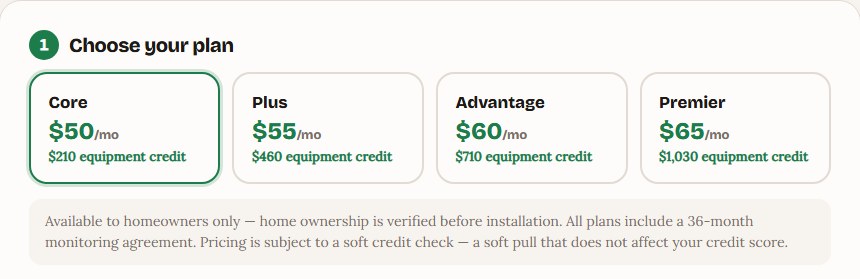
If someone offered you a new homeowner credit at your door, build the same system on our quote page and compare the monthly rate, the agreement and the equipment side by side. No visit, no deadline.
Frequently Asked Questions
Is there really a new homeowner alarm program in Reno? +
Not in the way it is usually pitched. An equipment credit is a normal part of how alarm systems are sold: the company covers part of the equipment and earns it back over the monitoring agreement. A rep can usually offer that credit at any home on the street, new homeowner or not. Calling it a limited program for people who just closed is a way to create urgency.
Is the $1,000 equipment credit free money? +
No. It is a discount on equipment that comes with a multi-year monitoring agreement. The credit is real in the sense that you will not pay that equipment cost up front, but it is built into the deal you sign. Compare the monthly rate, the length of the agreement and the total you will pay, not the size of the credit. Also check the price of each item: a credit goes a lot less far when a door sensor is priced at $100 instead of the roughly $30 it costs at retail.
Does the offer expire if I don't sign tonight? +
Be skeptical of any deadline given at the door. If the same credit is available to every home, it will still be available after you have had a night to read the contract. Ask the rep to leave the offer in writing.
Does Kiwi Alarms offer an equipment credit? +
Yes, on every plan, every day. The credit ranges from $210 on Core to $1,030 on Premier. On top of it, the alarm panel is included and installation and activation are credited too. You can see each plan and build your own system on the quote page without talking to anyone. Plans are for homeowners, include a 36-month monitoring agreement and use a soft credit check that does not affect your score.
What should I ask a rep who offers a new homeowner credit? +
Ask whether your neighbor who has lived there ten years could get the same offer, whether the panel, installation and activation are included or counted against the credit, what the monthly rate and agreement length are, what the total cost over the agreement is, and ask for all of it in writing before you sign. You also have 3 business days to cancel a contract signed at your home under the FTC Cooling Off Rule.
Related reading: Safe Haven Security in Reno · Door-to-Door Alarm Sales Tactics · How to Cancel a Door-to-Door Alarm Contract · New Home Security Guide